

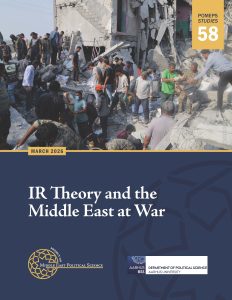
In December 2025, POMEPS convened a workshop at Aarhus University in Denmark, bringing together scholars to collectively interrogate these questions: what core concepts, theories, or hypotheses in Middle East IR require rethinking in the light of October 7 and its aftermath? What changes, if any, are needed in how we study the Middle East? Does Israel’s rapid expansion of military operations across the entire region and the potential outcomes of another war with Iran represent a change of the regional order or just a more routine evolution within the existing order? The workshop followed in the footsteps of a workshop hosted at Aarhus University a decade earlier, which had brought American, European, and Middle Eastern IR theorists into close dialogue about the field, and more recently built upon a POMEPS workshop on regional order hosted a year earlier at the European University Institute in Florence, Italy. This volume of POMEPS Studies collects papers from the Aarhus workshop, which interrogate a wide range of concepts.
Introduction – IR Theory and the Middle East at War: Challenges and Opportunities
Marc Lynch, The George Washington University & Morten Valbjørn, Aarhus University
The Persistence of US Hierarchy in the Gulf
Sean Yom, Temple University
Israel, the Axis of Resistance, and the End of Deterrence
Waleed Hazbun, University of Alabama
Egypt’s Foreign Policy and the Limits of Underbalancing Theory
May Darwich, University of Birmingham
Ma ba´d al-harb? Epochal Bookending and Arab Intellectual Reactions to the Gaza War
Sune Haugbølle, Roskilde University
The End of Sanctions? Rethinking Termination Processes through the Syrian Case
Hana Attia, Leuphana University & German Institute for Global and Area Studies
Jeroen Gunning, King’s College London
Defending Shrines, Defending Borders: Iran’s Syrian Intervention Reconsidered
Ehsan Kashfi, University of Copenhagen
Reassessing Principal–Agent Theory: The Houthis’ evolving relationship with Iran
Maria-Louise Clausen, Danish Institute for International Studies (DIIS)
Still an irreplaceable piece? Reflecting on the limits of Saudi reengagement in Lebanon
Anne Kirstine Rønn, Aarhus University
External Referents and the Dynamics of Opposition in the MENA
Massimo Ramaioli, Al-Akhawayn University & Francesco Cavatorta, Université Laval in Quebec